
Department of Emergency Medicine, The Fifth Affiliated Hospital, Southern Medical University, China.
Department of Emergency Medicine, The Fifth Affiliated Hospital, Southern Medical University, No. 566 Congcheng Avenue, Conghua District, Guangzhou 510900, Guangdong Province, China.
Email: kangxin123@smu.edu.cn
Received : April 23, 2025,
Accepted : May 20, 2025
Published : June 10, 2025,
Archived : www.jclinmedcasereports.com
Coagulation dysfunction is one of the most important complications of venomous snake bites. Here, we report on a 64-year-old man who was bitten by Trimeresurus mucrosquamatu, a blood-venomous snake, while farming in the mountains. The patient quickly ran down the hill after the bite and quickly developed bleeding in the gums, elbow and popliteal skin en route to the hospital. Blood coagulation function test and thrombologram test showed that the patient’s blood was in a very low clotting state. The patient’s condition improved rapidly after injection of antivenom, infusion of fresh frozen plasma and anti-infection treatment. This case brings us some enlightenment. First, after being bitten by a snake, do not run fast, so as not to accelerate the toxin into the blood circulation; Secondly, some items should be used to prevent toxins from returning to the heart at the injured site. Finally, thrombus elastic imaging test can evaluate the coagulation function after snake bite more comprehensively and accurately, and it is recommended to use it after blood poison bite.
Keywords: Trimeresurus mucrosquamatu; Bite; Coagulation dysfunction; Thromboelastogram; Antivenin.
Copy right Statement: Content published in the journal follows Creative Commons Attribution License (http://creativecommons.org/licenses/by/4.0). © Kang X (2025)
Journal: Open Journal of Clinical and Medical Case Reports is an international, open access, peer reviewed Journal mainly focused exclusively on the medical and clinical case reports.
Snake bite is one of the major public health problems, primarily affecting rural populations in tropical and subtropical countries around the world. Globally, about 5.4 million people are bitten by snakes each year, of which 1.8 - 2.7 million are poisoned and 80,000-140,000 die from snakebites [1-2]. However, these figures are not very accurate, and many snakebite cases are not counted or reported. There are many kinds of poisonous snakes, among which the Trimeresurus mucrosquamatu is a kind of blood poisonous snake. Patients bitten by the Trimeresurus mucrosquamatu appear dizziness, nausea and vomiting, visual disorders, confusion and other symptoms, some can also appear subcutaneous bleeding, facial bleeding, urine and feces bleeding and other systemic bleeding symptoms. If the patient bitten by the Trimeresurus mucrosquamatu cannot take or inject effective detoxification drugs in a timely and effective manner, it will lead to circulatory failure or kidney failure and death.
Coagulation dysfunction is one of the complications of an snake bite. Routine clotting tests are used to evaluate clotting function after snakebite, but they do not reflect the interaction of platelets and the clotting cascade. In recent years, Thromboelastography (TEG) has been paid more and more attention in clinical application [3]. TEG can reflect the process of blood coagulation and fibrinolysis more comprehensively and help to understand the coagulation mechanism more deeply. However, there are few literatures on the evaluation of coagulation function, diagnosis and treatment of TEG in snakebite. Early comprehensive assessment of coagulation function and correction of coagulation dysfunction is very important for the rehabilitation of patients with severe Trimeresurus mucrosquamatu based on TEG.
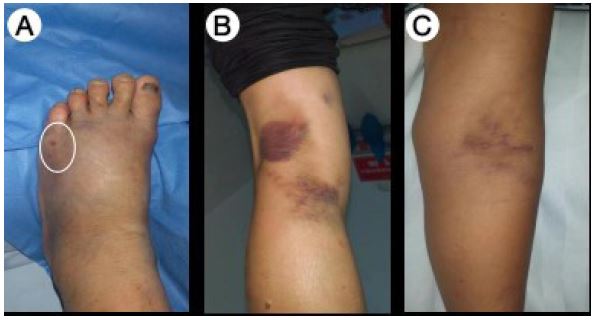
A 64-year-old man was bitten on his left foot by a Trimeresurus mucrosquamatu while working in the mountains. The patient immediately ran down the hill. The patient presented with two tooth marks on the left fifth toe, subcutaneous bruising and swelling on the left foot, positive peripheral tenderness, bleeding in the popliteal space, elbow, and gums, accompanied by abdominal pain and vomiting. The patient also had bleeding gums, followed by abdominal pain, vomiting, and bruising spots below the elbow. The platelet count was as low as (40×109/L), and the prothrombin time (PT, ≥170 s), activated partial thrombin time (APTT, ≥43.6 s) and thrombin time (TT, ≥170 s) were significantly prolonged. TEG examination showed that blood reaction time (R) and blood clot mechanical strength (G_TIL) were significantly prolonged, and the thrombosis rate (K), coagulation Angle (Ang, α), and thrombosis strength (MA) were significantly reduced, which suggesting that the blood of the patient was in an extremely hypocoagulable state (Figure 1). After the patient was admitted to the ward, he was given anti-pit viper serum, anti-pentaphanus venom serum, tetanus antitoxin, levofloxacin. The 400 ml of fresh frozen plasma was injected. The patient’s gingival and elbow bleeding gradually stopped. The patient was discharged 3 days after the bite. After a week’s follow-up, the patient recovered well.
Snakebites are a frequent health problem in mountainous areas. There are two related reasons for our case report: 1) the victim developed severe gum bleeding, elbow bleeding, and severe coagulation dysfunction earlier than other victims; 2) Thromboelastography is very useful for the comprehensive assessment of coagulation function and guidance of treatment after severe venomous snake bites.
In the course of disease progression and diagnosis and treatment, the following issues deserve special attention.Trimeresurus mucrosquamatus is a poisonous and aggressive species. The farmer was bitten by a snake and ran down the hill himself to get home, thereby mobilizing skeletal muscles and increasing blood flow and circulation of the venom to vital organs. Pressure immobilization of the limbs is recommended to limit the venom contained within the bitten limb and to delay its circulation through the blood and lymphatic system to the nervous system and other vital organs. The patient also failed to take this precaution, causing the toxin to spread rapidly throughout the body, leading to clotting disorders and distant bleeding earlier than other victims.
The Trimeresurus mucrosquamatus is a kind of blood-toxic venomous snakes, which often causes coagulation dysfunction. We are used to using conventional coagulation function tests, such as PT, APTT, TT, PLT and Fib to evaluate coagulation function [4]. However, conventional coagulation function tests, which only detect an isolated coagulation factor or time point, are obviously insufficient. TEG test can evaluate the whole process of coagulation including coagulation initiation, fibrin formation, platelet aggregation and fibrinolysis [5,6]. It is like a vivid documentary, documenting from the moment the blood begins to clot to the final dissolution of the clot. Every detail is clearly, continuously and completely presented. After being bitten by snake, the patient rapidly developed gingival and popliteal hemorrhage, and PT and APTT were significantly prolonged, suggesting that both endogenous and exogenous clotting pathways were blocked. After we injected the patient with antipit agkistrodon acutus antivenin and agkistrodon hyalys antivenin, the bleeding continued unchecked. The patient showed persistent bleeding from the pinhole at the blood collection site. At this time, a more comprehensive and accurate evaluation of the patient’s coagulation function is needed, but routine coagulation function tests do not give us this information. We scheduled this patient for TEG. It evaluated the clot initiation (R time), clot dynamics (K time and α Angle), clot dynamics (Maximum thrombotic Amplitude [MA], G and Clotting Index [CI]), and fibrinolytic activity (Ly 30 and EPL) of the clotting cascade. The results of these indicators showed that the clotting factor activity, platelet function and fibrinogen function of the patient were very low, and the patient’s blood was in a very low coagulation state, and the risk of systemic bleeding was very high. Based on the TEG results, we chose to give the patient fresh frozen plasma. Gingival and popliteal bleeding were improved 15 hours after the snake bite. Compared with traditional coagulation function tests, TEG is more sensitive and comprehensive in assessing coagulation abnormalities and predicting bleeding risk in snakebite patients, which can help clinicians define transfusion strategies and guide the selection of antivenomous serum, thereby reducing the chance of snakebite disability and death.
The lessons we can learn from this case are: 1) Do not run after the snake bite, so as not to promote the toxin into the blood circulation; 2) The proximal part of the injured site should use some items to block the toxin from flowing back into the heart; 3) Thromboelastography test is more comprehensive and accurate to evaluate the coagulation function after the bite of venomous snakes, and it is recommended to actively use it when clinically necessary.
Author contributions: Original draft of manuscript (LZY, YZX, CWX, KX); Paper revision and editing (WNN, OYBT,KX);Project funder (RHZ, KX).
Funding: President’s Fund Project of the Fifth Affiliated Hospital of Southern Medical University (YZ2023ZX06).
Informed consent statement: Informed consent form was signed for the use of antivenom serum and blood transfusions according to the requirements of The Fifth Affiliated Hospital, Southern Medical University.
Conflict of interest: The authors declare no conflict of interest.