
1Faculty of Medicine, Wayamba University of Sri Lanka, Sri Lanka.
2Department of Surgery, Faculty of Medicine, Wayamba University of Sri Lanka, Sri Lanka.
3Faculty of Medicine, Rajarata University of Sri Lanka, Sri Lanka.
Faculty of Medicine, Wayamba University of Sri Lanka, Sri Lanka.
Email: kalhara181023@kul.wyb.ac.lk
Received : February 20, 2025,
Accepted : March 19, 2025
Published : March 28, 2025,
Archived : www.jclinmedcasereports.com
Genitourinary injuries, while comprising approximately 10% of all trauma cases, rarely involve the male external genitalia. Among these, testicular avulsion remains one of the most critical and life-threatening injuries. This case report details the management of a 25-year-old male who sustained a testicular avulsion after a high-velocity road traffic accident. The patient, who was a pillion rider on a motorcycle, was ejected upon collision with a cement barrier, resulting in severe trauma to the perineal region, including complete avulsion of the right testis. Immediate resuscitation and wound management were performed at a local hospital, followed by transfer to a tertiary care center for definitive care. Despite initial stabilization and efforts to control hemorrhage, testicular salvage was not feasible due to contamination, delayed presentation, and the severe nature of the injury. A multidisciplinary approach, including wound debridement, vascular control, and the use of a rotational flap, was employed for optimal wound healing. The patient underwent temporary colostomy and suprapubic catheterization as part of comprehensive management. This case highlights the complexities of managing testicular avulsion and emphasizes the importance of early intervention and a tailored, multidisciplinary approach to optimize patient outcomes.
Keywords: Genitourinary injury; Trauma; Testicular avulsion; Testicular salvage; Multidisciplinary approach.
Copy right Statement: Content published in the journal follows Creative Commons Attribution License (http://creativecommons.org/licenses/by/4.0). © Jayasooriya HK (2025)
Journal: Open Journal of Clinical and Medical Case Reports is an international, open access, peer reviewed Journal mainly focused exclusively on the medical and clinical case reports.
Genitourinary injuries account for approximately 10% of all trauma cases, though injuries to the male external genitalia remain a rare entity in the literature [1]. Despite the high risk of injury to the male genitalia due to their extracorporeal location, scrotal and testicular injuries are exceptionally uncommon, representing only 1% of all trauma cases [1,2]. The rarity of these injuries can be attributed to the anatomical position of the testes, which are inherently mobile within the scrotum, as well as the scrotal skin’s elasticity, which allows the internal structures to shift during blunt trauma [3,4]. Additionally, the cremasteric reflex provides a protective mechanism, and the tunica albuginea offers further defense through its fibrous barrier and tensile strength [4,5].
Testicular and scrotal injuries can be categorized as either blunt or penetrating trauma, with blunt trauma being more predominant [4,6]. Blunt trauma typically occurs during contact sports and road traffic accidents, whereas penetrating trauma is more frequently associated with gunshot wounds and animal bites [7,8]. Although the mechanisms of injury differ, the morbidity and mortality associated with these injuries vary significantly. Penetrating trauma, in particular, is often complicated by secondary injuries to adjacent structures, such as the bladder and bowel [2,4].
Among testicular injuries, avulsion remains the most critical and life-threatening complication due to the risk of significant hemorrhage from easily retracted testicular vessels [1,2,4,8]. Immediate management of such injuries focuses on two primary goals: hemorrhage control and stabilization of the patient’s hemodynamic status. The first step is the arrest of bleeding, often through ligation of the testicular and spermatic cord vessels. While the salvage of the testis is pursued, it is contingent on the patient’s stability and the timing of presentation [1,6]. Testicular reconstruction, including microsurgical anastomosis, is possible if the patient presents within six hours of injury and remains hemodynamically stable.
Complex avulsions, however, necessitate more extensive interventions, including wide debridement and the administration of prophylactic antibiotics due to the high risk of infection. The scrotum’s local environment complicates antibiotic penetration, making infections challenging to manage. The successful salvage of the testis is associated with substantial improvements in the patient’s long-term quality of life, particularly in terms of psychological well-being, sexual health, and fertility [4]. While even brief interruptions in blood supply can significantly impact germ cell viability, testicular salvage is still attempted whenever possible.
Early intervention remains crucial for optimizing outcomes, as the likelihood of successful salvage is higher when explored within the first few hours following injury. Initial ultrasound with color Doppler imaging is commonly used to assess arterial blood flow, providing a non-invasive diagnostic option [5]. However, surgical exploration remains the gold standard in confirming the viability of the testis [4]. A multidisciplinary approach, including collaboration between genitourinary surgeons and plastic surgeons, is essential for optimal outcomes. The absence of widely accepted guidelines for managing such complex injuries presents ongoing challenges, emphasizing the need for continued research and standardization in the treatment of male testicular avulsion injuries.
This report highlights the complexities of testicular injury management and emphasizes the importance of early intervention and a tailored, multidisciplinary approach for improving patient outcomes.
A 25-year-old unmarried male presented following a severe road traffic accident in which he was a pillion rider on a motorcycle. Both the rider and pillion were intoxicated at the time of the incident, which resulted in a head-on collision with a cement barrier. The impact caused the pillion rider to be ejected from the motorcycle and violently strike a concrete bridge edge, sustaining significant trauma to the face, lower abdomen, groin, and lower limbs in this high-velocity injury.
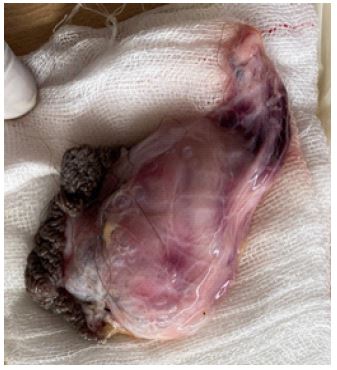
The patient was unable to recall the incident but was conscious and alert at the scene. He was unable to rise independently due to severe pain, and bystanders assisted him. Upon assessment, a severely bleeding wound was noted in the perineal region, with complete avulsion of the right testis, including the scrotal skin, which had separated entirely from the body. The wound was grossly contaminated due to the gravel road surface. The patient was promptly transported to a local hospital, where initial resuscitation efforts were initiated to control the hemorrhage. The bleeding arteries were ligated using sutures, which helped partially control the blood loss. The wound was irrigated with normal saline, and intravenous ceftriaxone was administered as part of the antimicrobial regimen. Opioids were provided for pain management.
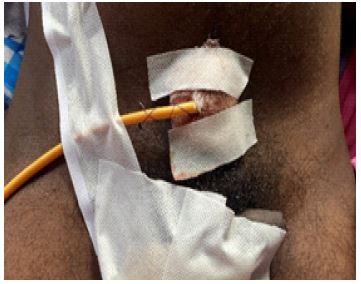
After initial stabilization, the patient was transferred to a tertiary care center for definitive care. Upon arrival at the tertiary care hospital’s emergency treatment unit, the patient was conscious, rational, and hemodynamically stable. There were no abnormalities detected in airway or breathing. However, his blood pressure was recorded at 100/60 mmHg, with a pulse rate of 140 beats per minute, suggesting impending hemodynamic shock due to significant blood loss. An emergency blood transfusion was performed with two units of O-negative blood, and continuous wound irrigation was carried out with additional administration of IV metronidazole. Following the transfusion, the patient’s blood pressure improved to 120/80 mmHg, and his pulse rate decreased to 120 beats per minute. A bedside ultrasound was performed to evaluate the blood supply to the left scrotum, which was found to be intact. However, the salvage of the right testis was considered doubtful due to extensive contamination and the prolonged duration since the injury (greater than 5 hours). Given these concerns, the patient was taken to the operating theater for definitive management. Wound debridement was performed, and a rotational flap was used to cover the exposed area after ligating the right testicular and spermatic vessels. Due to the inability to void urine and the presence of blood at the meatus, suprapubic catheterization was performed in consultation with the genitourinary team. A temporary defunctioning colostomy was also performed to reduce the risk of infection and facilitate wound healing.
The testis was not reimplanted due to the severe contamination, as the testis had not been preserved appropriately after the injury, and the delayed presentation further complicated its viability.
Genitourinary injuries, though constituting approximately 10% of all trauma cases, remain a rare occurrence in literature, particularly injuries to the male external genitalia, which represent only 1% of all trauma cases [1,2]. The rarity of testicular and scrotal injuries is largely due to the anatomical protection afforded by the mobility of the testes within the scrotum, the elasticity of scrotal skin, and the cremasteric reflex, which provides defense against direct trauma [3,4]. In cases of blunt trauma, such as road traffic accidents, scrotal injuries may occur, although they are relatively uncommon compared to other traumatic injuries [4,6].
Blunt trauma is most frequently encountered in contact sports and road traffic accidents, while penetrating trauma is typically seen with gunshot wounds and animal bites [7,8]. The mechanisms of injury vary, but the resulting complications differ significantly. For example, penetrating trauma often involves secondary damage to adjacent structures such as the bladder and bowel, complicating the clinical management [2]. Testicular injuries, particularly avulsions, pose significant challenges in both immediate management and long-term outcomes. Avulsion injuries, in particular, carry a high risk of hemorrhage, as the testicular vessels are easily retracted, making the first goal of treatment hemorrhage control critical [1,4,8].
The management of testicular avulsion is dictated by two primary goals: hemorrhage control and stabilization of the patient’s hemodynamic status. The first step in managing these injuries is the arrest of bleeding, commonly achieved through the ligation of the testicular and spermatic cord vessels [1,6]. Successful testicular salvage is contingent on prompt intervention, with microsurgical anastomosis possible if performed within six hours of injury, provided the patient remains hemodynamically stable6. However, the presence of contamination and the duration of time since injury complicate the feasibility of testicular reimplantation [4,5].
In this case, the patient’s injury was sustained in a road traffic accident, where the avulsion of the right testis, including the scrotal skin, resulted in gross contamination. The injury was further complicated by the delayed presentation, which exceeded five hours, making the chances of successful testicular salvage unlikely [6]. Contamination, as seen in this case, introduces a high risk of infection, and the scrotum’s local environment makes antibiotic penetration challenging, complicating the management of such injuries [1,4]. Prophylactic antibiotics are therefore essential to minimize infection risk [4]. Despite these challenges, early intervention remains crucial, as testicular viability is best preserved when explored early following injury [4,6].
Furthermore, a multidisciplinary approach, including collaboration between genitourinary and plastic surgeons, plays a critical role in optimizing outcomes in complex avulsion cases. The use of wound debridement and rotational flap coverage, as performed in this case, is an essential part of management in extensive injuries where testicular salvage is no longer possible [5,6]. Additionally, the management of secondary complications, such as urinary retention, necessitates coordination with the genitourinary team. Suprapubic catheterization was performed in this case due to the patient’s inability to void urine, a common complication of severe pelvic trauma [8].
In conclusion, the management of traumatic testicular avulsion requires early, aggressive intervention, particularly within the first six hours of injury, to improve the chances of testicular salvage. In cases where salvage is not possible, wound debridement, wound closure, and careful management of secondary complications, such as infection and urinary retention, are essential for improving patient outcomes. The complexity of such injuries highlights the need for continued research and the development of standardized management protocols to guide clinical practice in handling male genital trauma [4,6].
Testicular avulsion is a rare and potentially life-threatening injury that requires rapid, coordinated care to manage both the immediate hemorrhagic complications and the long-term consequences for fertility and psychological well-being. Despite the challenges presented by contamination, delayed presentation, and the severity of the injury, early intervention and a multidisciplinary approach remain essential for optimizing outcomes. While the salvage of the testis was not feasible in this case, timely resuscitation, wound care, and stabilization were critical in preventing further morbidity. This case underscores the need for greater awareness and standardized protocols for the management of traumatic testicular injuries to improve patient outcomes in such rare and complex cases.
Acknowledgements: We would like to express our gratitude to the healthcare professionals involved in this case, particularly the genitourinary and plastic surgery teams for their expertise. Their collaborative efforts were essential in ensuring optimal care for the patient.
No funding: This case report was not funded by any external organizations. The authors independently conducted the research and wrote the report without any financial support.
Conflict of interest: The authors declare that there are no conflicts of interest regarding this case report. No financial or personal relationships influenced the outcomes or content of this study.